

Table of Contents
- Why Buy From Independent Creators: The Local Economic Impact
- Benefits of Handmade vs Mass Produced: Quality and Environmental Stewardship
- How to Identify Sustainable Small Businesses: A Consumer Vetting Framework
- The 'Ethical' vs 'Local' Distinction: Why It Matters
- Personalized Service and Cultural Identity in Small Ethical Studios
- Long-Term ROI and Community Growth: The Consumer's Return
- Frequently Asked Questions
Last Updated: September 17, 2026
Why Buy From Independent Creators: The Local Economic Impact
Spending your money with independent makers does more than fill a shelf at home. Every purchase at small ethical studios keeps a larger share of that dollar circulating inside the local economy instead of routing it to distant shareholders and overseas factories.
This guide from JK Creation Finds breaks down the real benefits of supporting small ethical studios, from job stability to environmental gains, and gives you a practical framework for telling a genuinely ethical maker apart from one that just uses the right words.
The core mechanism is what economists call the local multiplier. A dollar spent at a neighborhood studio tends to be re-spent nearby, on rent, supplies, and wages, before it leaves the area.
Job Creation and Employment Stability
Small studios tend to hire locally and keep people on longer. A maker who sells directly to customers isn't chasing the seasonal spikes that force big retailers into constant hiring and layoff cycles.
Many small business owners report that steady, repeat customers let them plan production months ahead. That predictability is what turns a part-time role into a stable one.
Local Tax Revenue and Capital Circulation
Money spent with a local studio stays in the community longer. Those businesses pay local taxes, use nearby suppliers, and often bank with community institutions.
The result is a slower leak of capital out of the region. A purchase that feels small to you adds up across hundreds of households doing the same thing.
Benefits of Handmade vs Mass Produced: Quality and Environmental Stewardship
Handmade goods are built in smaller batches, which changes both how long they last and how much waste they generate. That trade-off between durability and disposability is the heart of the handmade versus mass produced debate.
Quality Craftsmanship and Long-Term Value
Mass-produced items are engineered for speed and low unit cost. Handmade pieces are built to be repaired, adjusted, and kept.
Small-batch production also means fewer shortcuts on materials. A maker who signs their work has a reputation on the line with every piece.
Carbon Footprint Reduction and Sustainable Manufacturing
Local production shortens the distance between maker and buyer, which cuts shipping emissions. Smaller runs also mean less overproduction and less dead stock headed for a landfill.
The Environmental Protection Agency's guidance on sustainable materials management outlines how reducing waste at the production stage delivers some of the largest environmental gains.
Many sustainable small businesses go further, using recycled packaging and sourcing materials with certification. That combination of local production and responsible sourcing is what carbon footprint reduction looks like in practice.
How to Identify Sustainable Small Businesses: A Consumer Vetting Framework
Knowing how to identify sustainable small businesses comes down to asking the right questions before you buy. Vague claims are easy; verifiable answers are not.
Use this checklist to vet any studio you're considering:
- Does the shop name its materials and where they come from?
- Is there a published giving or donation policy with specifics?
- Can you find a physical address or studio location?
- Are there real customer reviews or testimonials you can check?
- Does the return policy protect you if quality falls short?
- Is personalization turnaround time stated clearly?
If a shop can't answer most of these, treat the ethical branding as marketing until proven otherwise.
Supply Chain Transparency and Material Certification
Transparency means the maker can tell you where materials came from and who made the product. Look for supply chain transparency statements and third-party material certification, such as recognized sustainable fabric certification programs.
Regulatory Compliance and Fair Labor Practices
Ethical studios follow the rules that govern labeling, advertising, and worker treatment. The Federal Trade Commission's guidance on environmental marketing claims explains how "green" claims must be substantiated, which is a useful standard to hold any brand to.
Fair labor practices and regulatory compliance aren't optional extras. They're the baseline that separates a real ethical studio from a slogan.
The 'Ethical' vs 'Local' Distinction: Why It Matters
Local and ethical are not the same thing, and treating them as synonyms is the most common mistake buyers make.
A business can be local and still cut corners on labor or materials. Another can be ethical but ship from far away. The label you want is both: local where it counts, ethical where it's verifiable.
Here's the distinction in practice:
| Claim | What It Actually Means | How to Verify |
|---|---|---|
| "Local" | Made or sold nearby | Studio address, in-person pickup |
| "Ethical" | Fair labor, honest sourcing | Published policies, certifications |
| "Sustainable" | Reduced environmental impact | Material sourcing, packaging details |
| "Handmade" | Made by hand, small batch | Process photos, maker interviews |
A shop that's only local gives you the economic benefits. A shop that's only ethical gives you the values alignment. The strongest choice is a studio that's transparent about both.
Personalized Service and Cultural Identity in Small Ethical Studios
Personalized service at a small studio isn't just friendlier, it changes what you can actually buy. When the person answering your email is the person cutting, stitching, or finishing the piece, custom requests that a mass retailer would reject as unprofitable become routine.
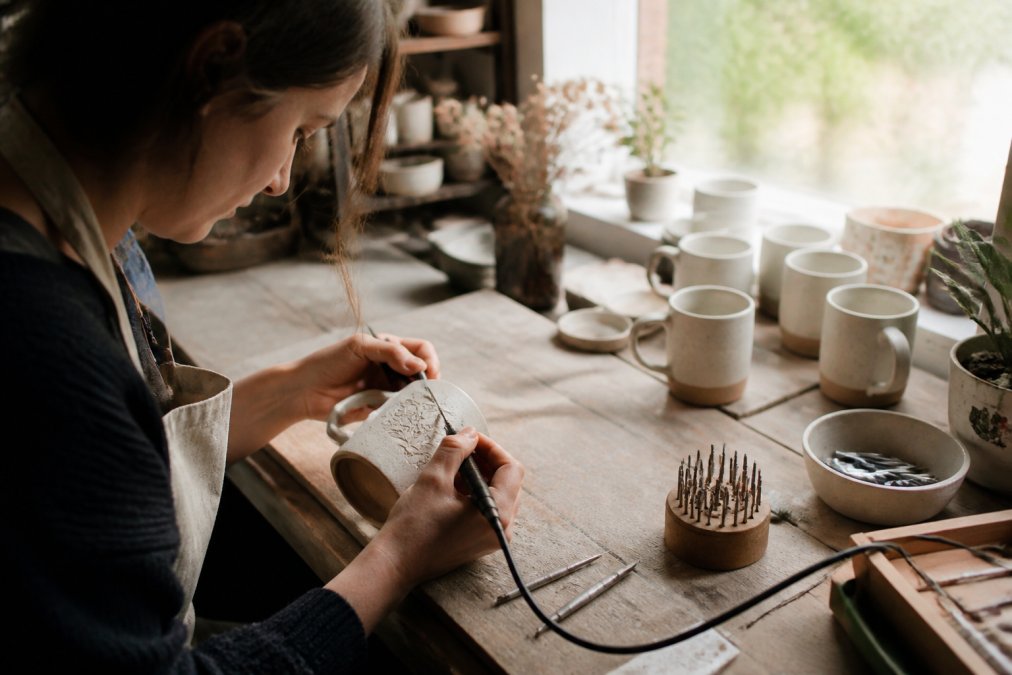
That's the practical difference. A chain's customization options are limited to whatever fits its production line.
What Personalized Service Actually Gets You
Concrete examples of what direct access to a maker enables:
- Fit and sizing adjustments that a standardized product can't offer, often at little or no extra cost.
- Material substitutions, swapping a lining, changing a hardware finish, or choosing a different thread color.
- Repair and refinishing down the road, often by the same hands that made the piece.
- Honest lead times instead of a warehouse estimate that may not reflect reality.
- Direct accountability, if something goes wrong, there's no call center script between you and a resolution.
Cultural Identity: What You're Actually Buying
Cultural identity in a small studio is more than aesthetic. A maker rooted in a specific place carries that place's design vocabulary into the work. That's why handmade pieces rarely feel interchangeable with mass-market equivalents, the decisions behind them were made by someone with a point of view, not a product committee.
But 'cultural identity' is also one of the easiest claims to make and one of the hardest to verify. This is where the ethical-versus-local distinction matters most.
How to Vet Cultural and Heritage Claims
A studio that genuinely carries cultural identity can usually answer these without hesitation:
- Where did the technique come from? A named tradition, region, or teacher is a good sign. A vague 'inspired by global artisans' is not.
- Who actually makes the piece? Named makers, process photos, or studio tours beat stock imagery every time.
- Are the materials regionally specific? If the studio claims a heritage material, it should be able to say where it's sourced.
- Does the maker credit their influences? Ethical studios tend to name the communities, teachers, or traditions they draw from rather than absorbing them anonymously.
Why This Matters for You as a Buyer
When it's borrowed without credit, your money funds extraction rather than preservation. The difference is usually visible in how transparent the studio is about its own origins, and that transparency is something you can check before you buy.
Long-Term ROI and Community Growth: The Consumer's Return
The long-term ROI for the consumer is the angle most guides skip. A well-made piece that lasts years costs less per use than a cheap one you replace twice.
Add the resale value of quality craftsmanship, and the math tilts further toward buying once and buying well.
Community growth compounds on top of that.
Frequently Asked Questions
What defines an ethical small studio?
An ethical small studio is a business that prioritizes fair labor practices, supply chain transparency, and environmental stewardship. It often operates with a clear mission, such as donating a portion of profits to charity or using sustainable materials. For example, JK Creation Finds, a Portland-based studio, donates 1% of profits annually and creates nature-inspired designs. Ethical studios also ensure regulatory compliance and avoid exploitative practices, distinguishing them from mass producers.
How does buying from small studios impact the local economy?
Buying from small studios creates a local economic multiplier effect. Money spent at independent creators stays in the community, funding local jobs, infrastructure, and public services through local tax revenue. Studies show that small businesses generate more local economic prosperity per dollar than large chains. This capital circulation supports resilient local economies and community growth, while also preserving cultural identity and uniqueness.
How can I verify if a studio is truly ethical?
To verify a studio's ethics, look for supply chain transparency, material certifications (such as sustainable fabric certification), and clear statements about fair labor practices. Check if they disclose where products are made and if they comply with US regulations. Customer advocacy groups and third-party certifications can help. For example, JK Creation Finds shares its Portland studio location and charitable donations, offering proof of its ethical claims.
What are the environmental benefits of supporting independent creators?
Independent creators often use sustainable manufacturing methods that reduce carbon footprint. Handmade vs mass produced goods typically involve less waste, lower energy consumption, and ethical sourcing of materials. Small studios are more likely to adopt circular economy principles, such as using recycled packaging. Supporting them encourages environmental stewardship and reduces the environmental impact of the retail industry.
The challenge with conscious shopping is that "ethical" and "local" get used loosely, and it's hard to know which studios actually back up their claims. At JK Creation Finds, we build nature-inspired hoodies, mugs, t-shirts, and wall art in our Portland studio, donate 1% annually, and offer free shipping and returns so you can try a piece risk-free. Shop All and support a studio that shows its work.

