

Table of Contents
- Why Verifying Ethical Business Practices Matters
- Understanding Ethical Business Practices and Legal Compliance
- Create an Ethical Business Practices Checklist
- Verify Ethical Business Certifications and Credentials
- How to Spot Greenwashing and False Claims
- Review Company Code of Conduct Examples and Documentation
- Conduct Supply Chain Transparency and Supplier Verification
- Establish Ongoing Monitoring and Risk Assessment
- Frequently Asked Questions
Last Updated: October 9, 2026
Why Verifying Ethical Business Practices Matters
When you shop, your money votes. Knowing how to verify ethical business practices means your purchases align with your values instead of contradicting them.
Many consumers discover too late that a company's public image doesn't match reality: a brand claims to be sustainable while its supply chain relies on exploitative labor, or touts environmental responsibility while dumping waste.
At JK Creation Finds, we believe transparency builds trust. We're committed to showing exactly how our products are made and where our materials come from.
Understanding Ethical Business Practices and Legal Compliance
Ethical business practices are the standards a company follows beyond what law requires. Legal compliance means following regulations. Ethics means going further.
A company can follow every law and still operate unethically, paying minimum wage legally while workers can't afford rent, or dumping waste within legal limits while poisoning a river.
Ethical business practices typically include:
- Fair wages and safe working conditions
- Environmental protection beyond regulatory minimums
- Honest marketing and transparent supply chains
Create an Ethical Business Practices Checklist
Start with a simple checklist to evaluate any company consistently.
Basic Ethical Business Practices Checklist:
- Company publishes a code of conduct
- Code of conduct covers labor standards and environmental impact
- Supply chain information is publicly available
Use this checklist before making a purchase. A company that checks most boxes likely takes ethics seriously; one that checks few may prioritize profit over principles.
Verify Ethical Business Certifications and Credentials
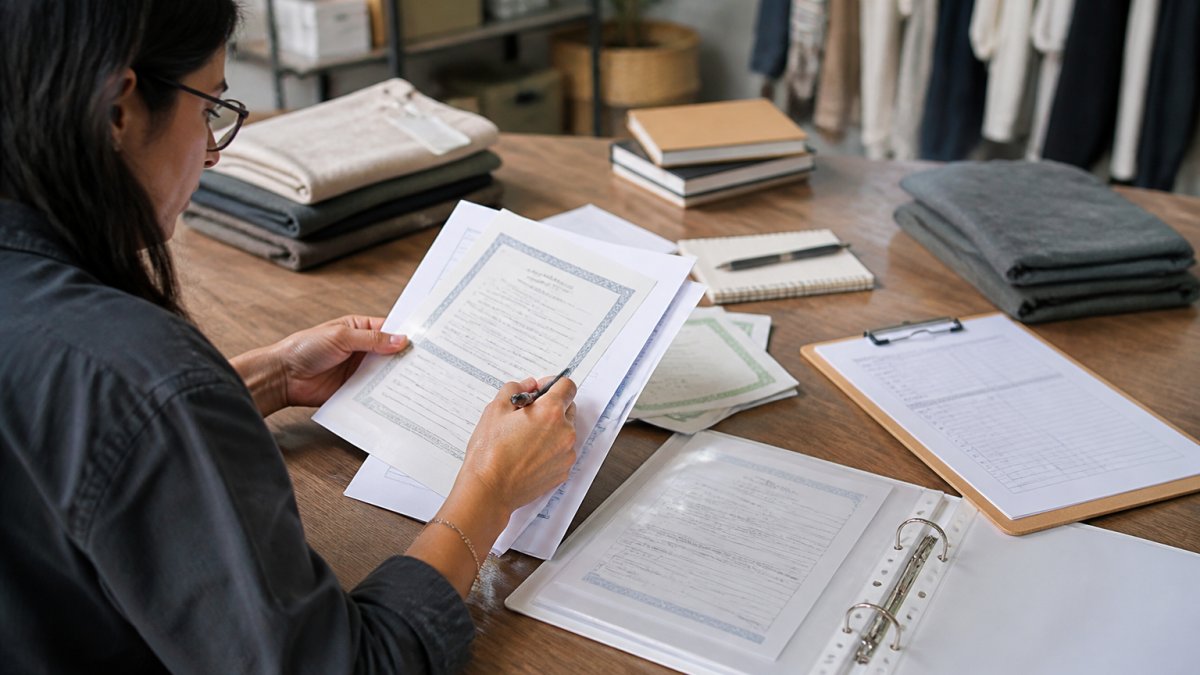
A certification is only as good as your ability to confirm it. Logos are easy to copy, PDFs easy to edit, and expired certificates easy to leave on a website. The step most buyers skip is the one that matters: checking the certificate against the issuer's own registry, not the company's marketing page.
What a real certification actually contains
A legitimate certificate has verifiable fields. If any are missing, treat the claim as unverified:
- Issuer, the accredited body that performed the audit, not the brand displaying the logo
- Certificate number, a unique identifier you can search in the issuer's public database
- Scope, the specific standard, product line, or facility covered (a certificate for one factory does not cover a brand's entire supply chain)
Step-by-step authentication
- Get the certificate number from the company. Ask customer service or check the sustainability report. A company that cannot produce a number is a red flag.
- Go to the issuer's website directly. Type the domain yourself, a company-provided link can point to a lookalike page.
- Search the issuer's public registry. Most credible certifiers maintain a searchable database; if there is none, that limits how much you can verify.
- Match every field. Confirm the legal entity name, covered sites, scope, and validity dates line up with the claim.
- Check the certifier's accreditation. A certificate from an unaccredited body carries far less weight.
- Confirm the certificate is current. Expired certificates are common because nobody updates the page.
A logo is not a certificate. "Eco-friendly," "green," "natural," and "sustainable" are marketing words with no defined standard. If there is no issuer, no number, and no registry entry, you are looking at a claim, not a certification.
Common certification families and what they cover
Match the certification to the claim being made:
- B Corp Certification, verifies a company's overall social and environmental performance, governance, and accountability through a scored assessment administered by B Lab. It covers the company, not a single product.
- Fair Trade Certified, focuses on producer and worker terms: minimum prices, premiums, and labor conditions for specific commodities.
- USDA Organic, a U.S. government standard for agricultural production and handling. Look for the USDA organic seal and the certifier's name on the package.
Red flags in certification claims
- A certificate with no number, no issuer, or no expiration date
- A logo that does not match the official mark (check the certifier's brand guidelines)
- A certificate covering one facility used to imply coverage of an entire brand
Verification is a five-minute task if you know the fields to check: issuer, number, scope, sites, dates, accreditation, and chain of custody. If any field is missing or does not match the claim, the certification does not support what the company is telling you.
B Lab's public directory of certified B Corporations
How to Spot Greenwashing and False Claims
Greenwashing happens when a company exaggerates or misrepresents its environmental efforts to appear ethical without changing practices.
Common greenwashing red flags:
- Vague language like "natural," "eco-friendly," or "sustainable" without explanation
- Green packaging that suggests environmental responsibility but says nothing about the product
- Claims about one small initiative while ignoring major environmental impact
Real companies give specifics: "We reduced emissions by 23% since 2024," not "We care about the environment." They name suppliers, publish audit results, and welcome questions. Ask yourself: Can I verify this claim? A genuine company says "We're working toward carbon neutrality by 2030" and shows progress; a greenwashing company says "We're committed to the planet" and changes nothing.
Review Company Code of Conduct Examples and Documentation
A code of conduct is a company's promise about how it operates, covering labor practices, environmental standards, and business integrity.
Good codes of conduct include:
- Specific labor standards (minimum wage, working hours, safety requirements)
- Environmental commitments with measurable goals
- Supplier expectations and audit processes
Where to find a company's code of conduct:
- Company website (usually in "About" or "Sustainability" section)
- Annual sustainability report
- Investor relations page
- Direct request to customer service
Read it carefully. Vague codes are often meaningless. Specific codes with measurable goals show real commitment.
Compare what the code says to what the company actually does. A code promising fair wages means nothing if workers report exploitation. A code protecting the environment means nothing if the company faces pollution lawsuits.
Conduct Supply Chain Transparency and Supplier Verification
Supply chain transparency is where ethics either prove real or fall apart. Promises about your own company are easy; guaranteeing ethics across every supplier, subcontractor, and raw-material source is much harder.
Custom Business Card Template, Editable Professional Business Card →
Most published supplier lists stop at Tier 1, the factory that assembles the finished good. The worst risks usually sit deeper: Tier 2 (components and materials), Tier 3 (raw materials), and the subcontractors and labor brokers that never appear on any list.
Start with a risk-based map, not a full audit
You cannot verify every tier of every product, so prioritize. A common approach scores each tier on two axes: likelihood and severity of harm.
Higher-priority checks:
- Raw-material origins in sectors with known forced-labor or conflict-mineral exposure
- Subcontracting and labor-broker arrangements, which are frequently invisible to the brand
- Facilities in regions with weak labor enforcement or recent sector-wide violations
- Suppliers with a history of repeat findings or unresolved corrective actions
Lower-priority checks:
- Tier 1 facilities with recent, unannounced third-party audits and no open findings
- Suppliers in sectors and regions with strong enforcement and stable records
This mirrors the risk-based due diligence frameworks large buyers use: spend verification effort where harm is most likely and most severe.
Questions that produce verifiable answers
Generic questions get generic answers. Ask for artifacts:
- Can you share your full supplier list, including Tier 2 and Tier 3 where known?
- Which facilities have been audited in the last 12 months, by whom, and what were the findings?
- How do you identify and monitor subcontractors and labor brokers?
- What is your process for tracing raw materials to origin?
A company that answers with documents is verifiable; one that answers with adjectives is not.
Corroborate audits with worker perspectives
Audit reports are a starting point, not proof. Clean audits and worker accounts often diverge, because audits are scheduled, workers fear retaliation, or the audited site is not where the work actually happens.
Ways to corroborate:
- Look for confidential worker interview findings in the audit report, not just management interviews
- Check whether the audit included off-site or anonymous interviews
- Search for worker-generated reports, union filings, or NGO investigations naming the facility
- Look for a functioning grievance mechanism with published response times and outcomes
Retaliation risk is real. Workers who report conditions can lose shifts, pay, or their jobs. When you read audit summaries, check whether the methodology protected worker anonymity. A finding of "no issues" from management-only interviews is weak evidence.
Verify supplier claims step by step
- Request the supplier list, including tiers where disclosed
- Research each named supplier independently, ownership, location, and history
- Search public records and news for labor, environmental, or safety violations
- Look for independent audit schemes (SA8000, SMETA, BSCI, and similar)
- Cross-check audit findings against worker reports and NGO investigations
- Verify any certifications directly with the issuing body's registry
- Note which tiers are undisclosed, silence is itself a data point
Red flags in supply chains
- Company refuses to name any suppliers
- Supplier list stops at Tier 1 with no explanation of deeper tiers
- Suppliers are shell entities with no verifiable operations
- History of labor or environmental violations at named facilities
Track remediation, not just findings
Verification is not a snapshot. The most useful signal is whether a company closes the problems it finds. Ask for:
- The corrective action plan tied to each finding
- Closure dates and evidence of resolution
- Whether the same finding has recurred across audits
- Whether suppliers with unresolved findings are still in the supply chain
A company that publishes findings and closures is doing the harder, more credible work; one that only publishes logos is not.
At JK Creation Finds, we believe supply chain transparency builds customer confidence.
Establish Ongoing Monitoring and Risk Assessment
Verification isn't a one-time check. Companies change, new suppliers come on board, and standards slip.
Create a monitoring system:
- Set calendar reminders to review the company's sustainability reports annually
- Subscribe to the company's newsletter or updates
- Check news sources for any scandals or violations
- Review customer reviews and worker testimonials
Track changes over time: Is the company improving, addressing problems you've identified, and responding to criticism?
Risk assessment helps you decide which companies deserve your money most. Score them:
| Risk Factor | High Risk | Medium Risk | Low Risk |
|---|---|---|---|
| Supply chain transparency | Refuses to disclose | Limited information | Detailed, verifiable |
| Third-party audits | None or outdated | Annual audits | Frequent, recent audits |
| Labor practices | History of violations | No public data | Certified standards met |
| Environmental impact | Major violations | Unverified claims | Measurable reduction |
| Grievance response | Ignores complaints | Slow response | Quick resolution |
| Certifications | None or questionable | One relevant cert | Multiple recognized certs |
Companies scoring high across all categories deserve your business. Companies scoring low should be avoided until they improve.
Verifying ethical business practices takes time, but it's the only way to align your spending with your values.
Ready to support businesses that truly practice what they preach? Explore our custom business card templates and other handcrafted products, each made with integrity and care.

Frequently Asked Questions
How can you tell if a business is ethical?
Look for third-party certifications, transparent supply chain information, and a published code of conduct. Check if the company discloses labor practices, environmental standards, and factory conditions. Review independent ratings and third-party audits. Verify claims through public disclosure documents and certifications from recognized bodies. Ethical businesses openly share information about their sourcing practices, worker treatment, and environmental responsibility without vague marketing language.
What certifications help identify ethical businesses?
Reputable certifications include Fair Trade, B Corp, ISO 14001 (environmental management), SA8000 (labor standards), and Forest Stewardship Council (FSC) for materials sourcing. Each certification requires independent verification and regular audits. Verify certifications by checking the issuing organization's website and confirming the company's current status. Be cautious of lesser-known credentials without third-party backing. Legitimate certifications display audit dates, scope, and renewal timelines.
What are common signs of greenwashing?
Greenwashing includes vague claims like 'eco-friendly' without specifics, highlighting one sustainable feature while ignoring harmful practices, using green imagery without evidence, and lacking third-party verification. Red flags include no supply chain transparency, absence of labor standards documentation, unsubstantiated sustainability claims, and refusal to disclose factory locations or working conditions. Companies engaging in genuine ethical conduct provide detailed evidence, certifications, and accountability mechanisms, not just marketing language.
How do I verify a company's sustainability claims?
Request specific data: sourcing locations, material composition, production methods, and environmental impact metrics. Cross-reference claims against third-party certifications and independent ratings. Review published sustainability reports with audit dates and scope. Check for worker grievance channels and corrective action documentation. Verify material choices through supply chain traceability. Ask for evidence of durability and repairability standards. Genuine companies provide detailed documentation; those with vague claims or refusals to share data are likely misrepresenting their practices.

