

Last Updated: October 22, 2026
Quick Summary
Charting nature vs artykoala comes down to style: Charting Nature sells vintage naturalist and scientific illustration prints, while Artykoala sells modern, decorative nature prints. Charting Nature suits studies and home offices, Artykoala suits bedrooms and modern living rooms. Neither is automatically better, so choose by your room's existing style and wall scale.
- Vintage reproduction is less forgiving of cheap printing than contemporary flat-color artwork, so scrutinize paper and ink specs.
- Confirm whether the listed size is the image area or the paper edge before ordering from either brand.
- Art above furniture should fill roughly two-thirds to three-quarters of the furniture's width.
- Buy the frame after the print, since odd sizes force costly custom framing.
- Screenshot the product page with size, paper, frame, and return terms before checkout.
Table of Contents
- Charting Nature vs Artykoala: What Actually Separates Them
- Side-by-Side Comparison: Products, Prices, and Policies
- How to Choose Nature Wall Art That Fits Your Space
- Print Quality and Production: What Your Money Buys
- Nature-Inspired Bedroom Decor: Styling Botanical and Bird Prints
- Wall Art Size Guide for Bedrooms: Getting the Scale Right
- Shipping, Returns, and Customer Support Compared
- The Verdict: Which Brand Fits Your Home and Budget
- Frequently Asked Questions
Charting Nature vs Artykoala: What Actually Separates Them
Charting Nature vs Artykoala is a comparison worth making carefully, because both brands sell nature wall art but they come at it from different directions. Charting Nature leans on vintage scientific and naturalist illustration, while Artykoala leans toward modern, decorative prints.
Here at JK Creation Finds, we design nature-inspired pieces for people who want their walls to feel like a walk through the woods.
Charting Nature at a Glance
Charting Nature is best understood as a naturalist print shop. Its catalog centers on vintage-style illustrations: bird prints, botanical studies, and wildlife artwork in the tradition of 19th-century scientific plates.
The strength here is authenticity of style. These prints read as educational art, which makes them a natural fit for a home office, a study, or a classroom. The tradeoff is that vintage illustration is a specific aesthetic.
Artykoala at a Glance
Artykoala sits at the other end of the spectrum. Its focus is contemporary decorative prints, with a broader, more trend-driven approach to nature imagery: mountains, oceans, sunsets, and abstract botanical shapes.
That flexibility is the draw. Contemporary prints slip easily into a bedroom aesthetic or a first apartment. What you give up is the sense of history that a vintage plate carries.
Side-by-Side Comparison: Products, Prices, and Policies
The comparison most shoppers actually want is concrete: what can you buy from each brand, in what size, at what price, and what happens if something goes wrong. Neither brand publishes a single flat price sheet, and listings change, so treat any number below as a representative range to verify on the product page at checkout rather than a locked-in quote.
| Feature | Charting Nature | Artykoala |
|---|---|---|
| Brand positioning | Naturalist and scientific illustration print shop | Contemporary decorative print shop |
| Core catalog | Bird prints, botanical studies, wildlife plates in the 19th-century scientific tradition | Mountains, oceans, sunsets, abstract botanicals, trend-driven nature imagery |
| Style register | Vintage, educational, collectible-feeling | Modern, casual, decorative |
| Typical print sizes | Small study prints through large-format statement pieces | Standard poster sizes through large-format |
| Framing | Framed and unframed options vary by listing | Framed and unframed options vary by listing |
| Paper and ink | Archival-style reproduction is the selling point; confirm weight and finish per listing | Decorative print production; confirm paper stock and ink rating per listing |
| Shipping format | Flat or rolled depending on size | Flat or rolled depending on size |
| Returns | Confirm window and who pays return freight on large items | Confirm window and who pays return freight on large items |
| Best fit | Study, home office, classroom, rooms with warm wood and books | Bedroom, living room, first apartment, rooms with white walls and light textiles |
What the table can't tell you
Three details decide most purchases, and neither brand puts them in one place. First, is the listed size the image area or the paper edge? A print sold as 16 x 20 inches with a wide border can leave you with a much smaller image than expected, and that mismatch is the single most common reason a framed piece looks wrong on the wall. Second, is the print archival or decorative? Archival implies pigment or pigment-compatible inks rated for decades of display; decorative means the color may shift under direct sunlight within a few years. Third, what does the frame include? A listing that says "framed" may mean a thin composite frame with acrylic glazing rather than glass, and that changes both the look and the shipping risk.
A practical way to price the two options
Build the total cost before you compare brands, because the sticker price is rarely the number you pay. Add the print, the frame if it isn't included, shipping, and sales tax, then subtract any first-order discount. A large-format print that ships rolled typically costs less to ship but requires a frame and a mat, which can push the all-in total above a framed piece that ships flat.
The honest takeaway: these brands rarely compete for the same wall. They compete for the same shopper at different moments in that shopper's decorating life, and the total-cost math above is what separates a good buy from a return.
How to Choose Nature Wall Art That Fits Your Space
Choosing nature wall art comes down to three filters: the room's existing style, the color palette you want to reinforce, and the scale of the wall you're filling. Get those right and the brand decision becomes obvious.
Start with what's already in the room. A space with warm wood, leather, and books pulls vintage prints toward it. A space with white walls, light textiles, and minimal furniture pulls contemporary prints.
Then check the palette. Botanical and fern prints in muted greens and creams calm a busy room. Bird prints with saturated plumage add a focal point. Contemporary sunset and ocean prints bring in warmer tones.
Print Quality and Production: What Your Money Buys
Print quality is where marketing language gets vague and buyers get burned. The questions that actually matter are simple: what paper stock is used, is the print archival or decorative, and is color reproduction consistent across sizes. Here is what those terms mean in practice, so you can read a product listing the way a printmaker does.
Paper stock: weight, finish, and what they change
Paper weight is measured in pounds (lb) in the U.S. market, and the number tells you how the print will feel and how it will frame. A lightweight text-weight sheet in the 60-80 lb range feels like a poster and buckles easily in a frame without a mat.
Finish matters just as much. Matte and textured papers absorb light and suit vintage naturalist illustration, where fine line work and subtle shading need to read without glare.
Ink and archival rating
Archival is a specific claim, not a vibe. It generally means pigment-based inks rated for long-term display without noticeable fading, often described in terms of lightfastness under glass. Decorative printing may use dye-based inks that look vivid out of the box but shift under ultraviolet light, especially in a sunny room. Ask whether the print is rated for display in indirect light and whether it should be framed behind UV-filtering glazing.
Why vintage reproduction is harder than contemporary
Vintage-style reproduction is demanding. Fine line work and subtle shading in a bird illustration show every weakness in a cheap print process: banding in gradients, muddy midtones, and lost detail in the feather barbs. Contemporary prints are more forgiving because large areas of flat color hide small imperfections. That asymmetry means a budget print process hurts Charting Nature-style artwork more than Artykoala-style artwork, and it is the main reason to scrutinize paper and ink specs more closely on the vintage side.
Color consistency across sizes
A print sold in several sizes is usually produced from the same digital file, but the output can drift between a small sheet and a large-format piece if the printer, paper, or color profile changes. If you plan a gallery wall mixing sizes from one brand, order the smallest size first as a color check before committing to the large piece.
Ask both brands the same three questions before ordering: What is the paper weight and finish? Is the ink rated for long-term display? Does the listed size reflect the image area or the paper edge? That last one trips up more buyers than any other detail.
Nature-Inspired Bedroom Decor: Styling Botanical and Bird Prints
Nature-inspired bedroom decor works best when it supports rest rather than demanding attention.
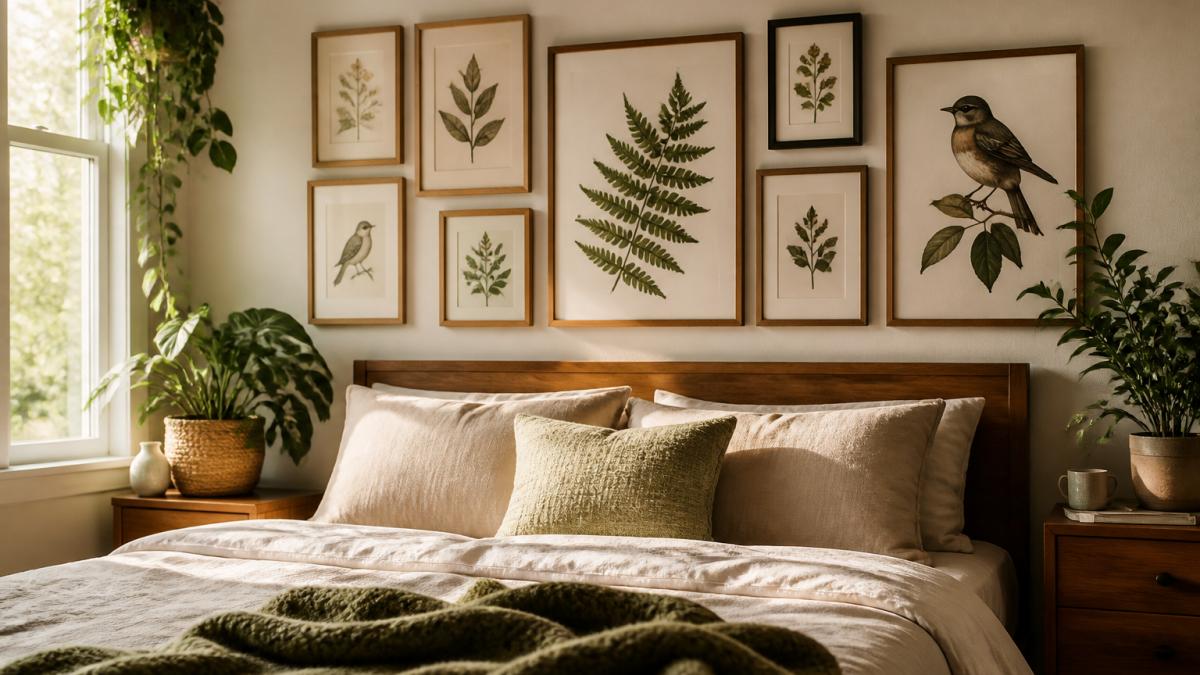
A gallery wall of fern and botanical prints above the bed is the classic move. Keep frames identical and let the artwork vary.
Mix vintage and contemporary only if you have a reason. A single antique bird print among modern botanical studies can look intentional. Several of each usually looks like an accident.
Wall Art Size Guide for Bedrooms: Getting the Scale Right
A wall art size guide for bedrooms starts with one rule: the art should fill roughly two-thirds to three-quarters of the width of the furniture beneath it.
For a single print above a bed, large-format is almost always the right call. A small print floating over a wide headboard looks lost.
- Above a queen or king bed: one large-format piece or a tight gallery cluster
- Above a dresser: a single medium print centered on the furniture
- Beside a reading chair: a small print at eye level when seated
Measure the wall, then tape the outline on it before you buy. Five minutes with painter's tape saves a return.
Shipping, Returns, and Customer Support Compared
Shipping and returns are where online art purchases are won or lost. Prints ship flat or rolled in a tube, and both methods carry risk: flat shipping can bend, tube shipping requires the buyer to flatten the print before framing.
Check three things before you order from either brand. First, whether large-format prints ship rolled and how long they need to flatten. Second, the return window and who pays return shipping on a large item. Third, whether customer service responds by email only or offers a phone line.
Damaged-in-transit policy matters most. A print that arrives creased should be replaced without argument. Confirm that policy in writing before checkout, not after.
The Verdict: Which Brand Fits Your Home and Budget
Charting Nature wins if you want vintage naturalist character: bird prints, botanical studies, and a room that feels like a study or a field journal. Artykoala wins if you want a clean, contemporary look that slots into a modern bedroom without a second thought.
Neither is the automatic choice. If you want nature-inspired pieces made by a small studio that knows the landscapes it draws from, our collection at JK Creation Finds is built exactly for that.
Frequently Asked Questions
What kind of wall art does Charting Nature sell?
Charting Nature focuses on nature-themed wall art, including bird prints, wildlife illustrations, botanical and fern prints, and vintage-style Audubon reproductions. Their catalog leans toward educational and naturalist subjects, which suits home offices, classrooms, and nature lovers who want accurate depictions of species. Artykoala takes a broader contemporary approach, mixing nature posters with modern graphic styles. If you want scientific accuracy and vintage character, Charting Nature is the closer match; if you want trend-driven color and minimalism, Artykoala fits better.
How does Charting Nature compare with Artykoala for home decor?
Charting Nature vs Artykoala comes down to style and priorities. Charting Nature offers vintage-inspired wildlife and botanical prints with an educational feel, while Artykoala leans toward contemporary nature posters and modern wall decor. Compare print sizes, paper quality, framing options, and shipping policies before deciding. Charting Nature suits traditional or naturalist rooms; Artykoala suits modern, minimalist spaces. Neither is universally better, so match the brand to your room style and budget rather than picking on name recognition alone.
How do I choose nature wall art for a bedroom?
Start with the room's color palette and mood, then pick subjects that support it: soft botanical and fern prints for a calming bedroom aesthetic, bird prints for a naturalist feel, or large-format landscape photography for a focal point. Check print size against your wall before ordering, confirm paper quality and framing options, and decide whether you want vintage or contemporary art styles. Order one statement piece first, live with it for a week, then build a gallery wall around it so the collection feels intentional.
What size nature print works best above a bed?
A common rule is to hang art that spans about two-thirds to three-quarters of the bed's width, leaving roughly 8 to 10 inches between the frame bottom and the headboard. For a queen bed, a single large-format print around 30 by 40 inches or a pair of smaller prints works well. For a king, go wider. Always measure the wall and tape out the footprint before ordering, and check the brand's size chart, since print sizes vary between Charting Nature and Artykoala.
The hardest part of decorating with nature art isn't finding a print you like. It's finding one that matches your room, arrives undamaged, and holds up on the wall for years. At JK Creation Finds, we craft nature-inspired wall art and cozy pieces in our Portland studio, with designs drawn from the landscapes we actually live in, free shipping and returns, and 1% of profits donated annually. Get started with JK Creation Finds and bring the calm of the outdoors into your home.

