

Table of Contents
- Why Nature Wall Art Belongs in Your Bedroom
- Botanical Prints and Floral Illustrations
- Scenic Landscape Photography and Mountain Views
- Forest, Woodland, and Earthy Tone Artwork
- Biophilic Bedroom Design Ideas to Pair With Art
- How to Arrange Wall Art in the Bedroom for Balance
- Where to Find Nature Inspired Wall Art for Bedrooms
- Conclusion: Create Your Calm Retreat
- Frequently Asked Questions
Last Updated: September 6, 2026
Your bedroom should be the one room in the house that quiets your mind, and the artwork you hang there plays a larger role than most people realize. Nature inspired wall art for bedrooms does more than fill empty wall space; it introduces visual calm, softens the hard edges of daily life, and creates a sanctuary you actually want to retreat to. Below, we break down the trending nature themes for 2026, how to arrange them for visual balance, and where to find pieces that feel personal rather than mass-produced.
Research in environmental psychology consistently shows that viewing natural scenes can lower stress markers and support relaxation (peer-reviewed research). The key is choosing artwork that aligns with your existing palette and the mood you want to wake up to each morning.
Why Nature Wall Art Belongs in Your Bedroom
The strongest argument for nature wall art in a bedroom is its proven effect on your nervous system. Views of greenery, water, and open skies trigger a restorative response that urban interiors cannot replicate, making it easier to unwind before sleep and wake with a clearer head.
Biophilic design, the practice of connecting interior spaces to the natural world, has moved from commercial offices into private homes for good reason. A bedroom styled around organic elements supports well-being and improves the room's aesthetic appeal without requiring a full remodel.
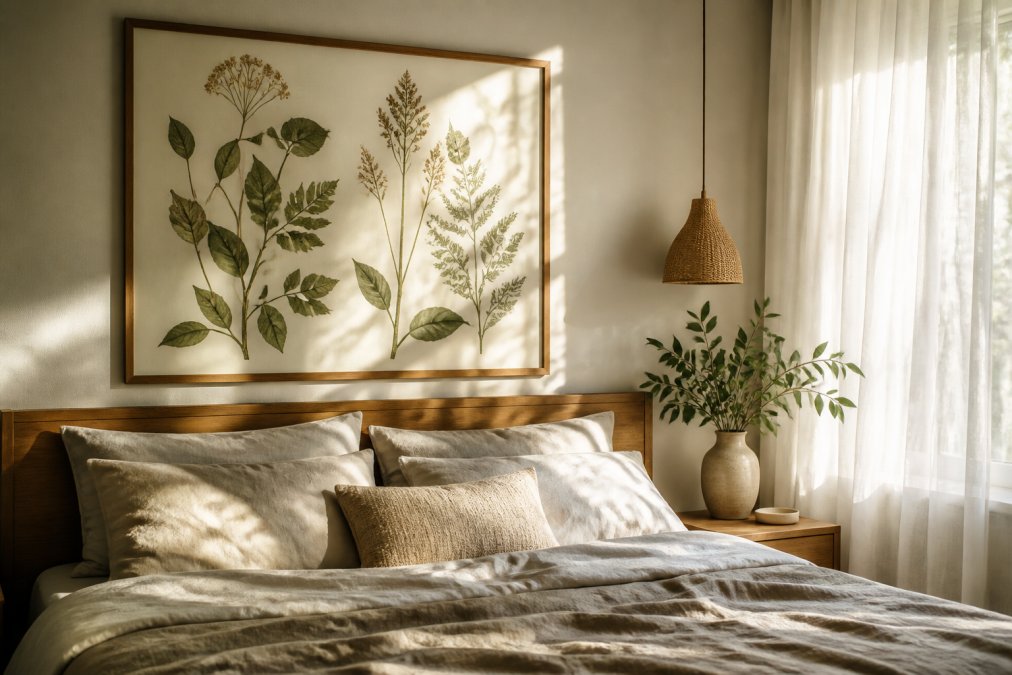
Botanical Prints and Floral Illustrations
Botanical prints remain the most versatile choice for bedrooms because they blend with almost any interior styling, from farmhouse to modern minimalism. But to make them truly work, you need to consider something the typical product roundup ignores: the quality of light in your room.
How Lighting Changes the Art You See
A botanical print is a study in subtle color shifts. The sage green in a eucalyptus stem or the dusty blush of a peony petal is rendered by pigment, but your eye perceives that color based on the light source hitting it. Most bedrooms use one of two lighting setups:
- Warm lighting (2700K-3000K): Common in bedside lamps and overhead fixtures with soft-white bulbs (energy.gov). Warm light amplifies red and yellow wavelengths. This makes warm-toned botanicals (terracotta, ochre, golden leaves) feel richer and more enveloping, but it can make cool-toned art (blue-greens, pale lavenders) look muddy or slightly gray.
- Cool lighting (4000K-5000K): Often found in LED vanity strips or daylight-balanced bulbs (energy.gov). Cool light sharpens contrast and makes cool-toned botanicals (fern greens, deep blues) appear crisper and more vibrant. However, it can wash out the warmth in cream backgrounds, making them look stark or clinical.
The Practical Takeaway for Your Bedroom
Before you commit to a botanical palette, check what bulbs are in your bedroom fixtures. If your room leans warm at night, choose prints with warm undertones, think goldenrod florals or olive-toned leaves. If your room uses cooler daylight bulbs, you have more freedom with jewel-toned or high-contrast illustrations. A common designer pattern is to install a dimmer switch and rely on warm 2700K lamps for evening wind-down, which makes almost any nature art feel softer and more inviting.
Beyond the Print: Texture as a Botanical Element
Botanical art extends to material. A pressed-flower frame (real botanicals preserved under glass) introduces an organic texture that a flat canvas cannot match, adding a subtle three-dimensional quality and authenticity. These pieces also interact beautifully with natural light, casting faint shadows that change throughout the day.
Sizing for Botanical Impact
For a single statement piece, the art should span roughly two-thirds the width of your headboard. A 36-inch-wide framed print above a queen bed (60 inches wide) leaves enough breathing room. For a series of smaller prints, treat them as one unit: the combined width of the frames plus spacing should still hit that two-thirds proportion.
Scenic Landscape Photography and Mountain Views
Scenic landscape photography brings a sense of vastness and open air into a bedroom, particularly effective in smaller rooms that lack natural views. Mountain scenery evokes tranquility by reminding you of places where the pace slows down.
Panoramic shots of ridgelines or misty valleys work best printed on canvas or framed as oversized art, allowing the eye to travel across the image. For a more subtle approach, choose black-and-white mountain photography that reads as texture and shadow rather than a literal postcard.
Consider the dominant color in the photograph. Artwork featuring earthy tones and muted blues pairs effortlessly with neutral bedding, whereas high-contrast images demand a more deliberate furniture palette.
Forest, Woodland, and Earthy Tone Artwork
Forest and woodland themes tap into a primal sense of shelter and quiet, making them a natural fit for the bedroom. Woodland motifs, whether a dense pine grove or a single stylized tree, introduce organic textures and a grounding presence.
Earthy tones, such as deep greens, warm browns, and soft ochres, are particularly on-trend for 2026 because they create a cocooning effect. These colors lower visual stimulation and pair seamlessly with natural materials like linen, wool, and untreated wood.
Biophilic Bedroom Design Ideas to Pair With Art
Nature inspired wall art performs best when it is part of a broader biophilic bedroom design strategy rather than an isolated purchase. The goal is to blur the line between indoor and outdoor spaces through layered textures, natural light, and organic forms.
Start by pairing your wall art with live plants or dried botanicals on a nightstand or dresser. Introduce wood, rattan, or stone accents in furniture and lighting to echo the materials in the artwork, strengthening the calm, cohesive mood.
Another effective approach is to treat the wall itself as a canvas. A gallery wall mixing small framed prints with a woven tapestry or a single sculptural piece adds dimension. Feng shui principles also suggest placing nature imagery where you can see it easily from the bed.
How to Arrange Wall Art in the Bedroom for Balance
The most common mistake in bedroom art placement is hanging pieces too high, leaving the wall feeling disconnected from the furniture below. As a rule, the center of your artwork should sit at eye level, roughly 57 to 60 inches from the floor, or about 6 to 8 inches above the headboard.
For a single large piece above the bed, choose artwork that spans roughly two-thirds the width of the headboard. Oversized art makes a bold statement and reduces visual clutter, supporting a minimalist, restful aesthetic.
When arranging a gallery wall, lay the pieces out on the floor first to map the spacing. Keep gaps between frames consistent, usually 2 to 3 inches, and balance the visual weight of larger pieces with smaller accents like a mirror or textile.
| Arrangement Style | Best Placement | Spacing Rule | Ideal For |
|---|---|---|---|
| Single oversized piece | Centered above headboard | 6-8 inches above headboard | Minimalist, bold focal point |
| Symmetrical pair | Flanking a window or bed | Equal distance from center | Traditional, balanced rooms |
| Gallery wall | Full wall or above dresser | 2-3 inches between frames | Eclectic, personal collections |
| Lean (no-hang) | On shelf or dresser top | Lean against wall at angle | Renters, flexible styling |
Where to Find Nature Inspired Wall Art for Bedrooms
Shopping for nature inspired wall art for bedrooms now means choosing between curated collections, independent marketplaces, and budget-friendly mass retailers. Each option offers a different tradeoff between price, uniqueness, and quality. But there is a fourth path: making it yourself.
The Retail Landscape at a Glance
For buyers who want a guaranteed cohesive look, curated collections from specialty decor sites provide ready-to-hang canvas prints with a professional finish. For specific scenic photography, large libraries offer extensive high-resolution imagery with color palettes curated for relaxation, though the sheer volume can feel overwhelming.
Independent artist marketplaces shine when you want a one-of-a-kind piece. These platforms connect you directly with creators, offering formats from framed prints to wall tapestries. The tradeoff is variability: quality and shipping times depend on the individual seller. For budget-conscious shoppers needing fast delivery, mass-market options offer abstract nature art, though designs are often reproduced at scale and lack originality.
The DIY Alternative: Claiming Your Own Wall
If the purchased options feel steep or soulless, the DIY route delivers both authenticity and savings. Here are three approaches requiring minimal skill and no specialized tools:
1. The Free Download Route
Numerous museums and public archives offer high-resolution scans of botanical illustrations in the public domain. The Biodiversity Heritage Library, for instance, hosts thousands of vintage flower and fern engravings. Download a few, print them on quality matte paper at a local print shop, and frame them with standard frames from a craft store.
2. The Pressed Botanical Frame
Collect leaves, ferns, or wildflowers from your own yard or a local park. Press them between heavy books for 7-10 days until fully flat and dry. Arrange them on acid-free paper inside a shallow shadow box frame. The result is a piece of art that is literally native to your region and cannot be replicated by any retailer. The key is patience: pressing too short a time leads to curling, and direct sunlight will fade the pigments within a few months, so hang it away from windows.
3. The Large-Scale Canvas Transfer
For oversized art without the oversized price tag, buy a blank canvas and a high-resolution nature photograph you have taken or downloaded from a free stock site. Print the image on standard copy paper in tile mode, then use a gel medium to transfer the ink onto the canvas. The process takes about an hour of active work plus drying time, and the final piece has a textured, painterly quality.
Matching the DIY Piece to Your Bedroom
A DIY piece works best when it follows the same proportion rules as purchased art. Above a headboard, aim for two-thirds the width of the bed. On a narrow accent wall, a single vertical piece (16x24 or 18x24) fills the space without overwhelming it. The advantage of DIY is that you control the exact color palette, so you can match a specific throw pillow or rug tone precisely.
Conclusion: Create Your Calm Retreat
Choosing the right nature wall art comes down to identifying the scenes that genuinely relax you and matching them to the scale and palette of your bedroom. Whether you lean toward delicate floral illustrations, expansive mountain photography, or grounding forest tones, the piece you select should make the room feel more like a retreat.
At JK Creation Finds, our wall art collection reflects the misty forests and rugged coastlines of the Pacific Northwest, crafted in our Portland studio with high-quality materials. We donate 1% of our annual profits to charitable causes, so your purchase supports both your sanctuary and a broader mission. Explore the collection and find the piece that turns your bedroom into a daily escape.
Frequently Asked Questions
Is nature wall art good for bedrooms?
Yes. Nature scenes like forests, mountains, and botanical prints support relaxation and can lower stress, which matters in a room meant for rest. The visual connection to the natural world helps create a calming atmosphere that supports better sleep. Choose pieces with earthy tones and soft lines to enhance the tranquil feel of your space.
What is the best art to put on my bedroom wall?
The best art for a bedroom is something that feels calming and personal to you. Serene landscapes, minimalist nature sketches, and botanical illustrations are popular choices because they bring tranquility without visual noise. For a cohesive look, select pieces that use earthy tones and organic textures that complement your existing bedding and decor.
What is the 2/3 rule for wall art?
The 2/3 rule suggests your wall art should be about two-thirds the width of the furniture beneath it. For example, if you have a queen bed that is 60 inches wide, your art piece or gallery arrangement should be around 40 inches wide. This proportion creates visual balance and anchors the wall, preventing the art from looking lost or oversized.
How do you choose wall art for a small bedroom?
In a small bedroom, one larger statement piece often works better than several small ones. It creates a focal point without making the room feel cluttered. Choose a piece with a light or airy feel, like a scenic landscape with soft colors, to make the space seem larger. Hang it at eye level to draw attention upward and enhance the sense of openness.

